






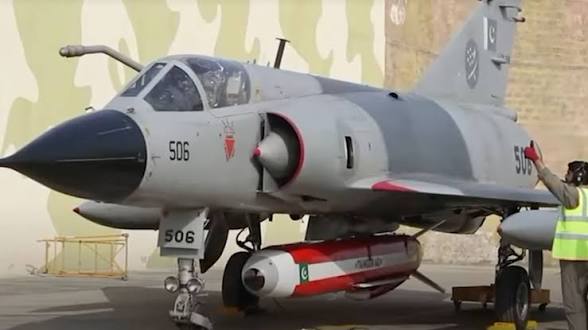
Pakistan recently carried out the test of a naval version of its newly unveiled Taimur Air Launched Cruise missile in the Arabian Sea. The test, as per Pakistan Navy’s statement, was carried out to validate operational parameters of the naval variant of the missile. Initially, Pakistan Air Force tested the missile’s land attack version. These tests, or the system in particular, are not simply another addition to Pakistan’s conventional strike arsenal. The repeated tests, timelines and the emerging tactical necessity in Pakistan – especially after the May 2025 conflict with India- signal a shift in Pakistan’s -offensive stand-off strategy based on the lessons from the conflict. This is the early depiction of a non-kinetic strategy where Taimur will be a pivotal pillar in an intra-service strike strategy. The article will synthesize the missile’s possible role in Pakistan’s strategy to counter India’s rapidly advancing stand-off capabilities, the technical dimensions of the system, and why the armed forces require a subsonic and not a hypersonic platform as a response to India’s Brahmos missiles. At a time when the South Asian strategic environment is being reshaped by advancements in air defence, precision-strike capabilities, and unmanned systems, Taimur’s rapid operationalization in multi-domain configuration appears to signal a quiet but important shift in Pakistan’s approach to deterrence.
During last year’s conflict, both states engaged in a shooting war from within their respective airspace and borders to inflict damage on each other. Indian Air Force initiated the hostilities by using SCALP-EG missiles and Hammer stand-off weapon launched from its new Rafale jets on the night of 6th/7th May, but in doing so, it also got its aircraft shot down by Pakistan Air Force’s long-range PL-15E air to air missile. India also deployed BrahMos cruise missiles against targets inside the Pakistani territory. In addition, India also employed standoff munitions against Pakistan. In response to this unprovoked aggression, Pakistan also used air launched CM-400 missiles against Indian air defense assets, while ground launched Fatah missiles also struck military sites in India.
India’s resort to such an arsenal was an escalatory step that served as an impetus for Pakistan to address any residual deterrence gaps in its conventional strike posture. Pakistan’s response has been multi-dimensional. It’s been almost one year since Pakistan engaged in a military confrontation with India. The conflict marked the beginning of non-contact warfare.
Pakistan took a key lesson from the May war on the need to expand its conventional standoff precision strike arsenal. Soon after May 25, Pakistan announced the creation of a dedicated rocket force. In September, that rocket force successfully tested the Fatah-4 cruise missile system, signaling a broader institutional commitment to stand-off strike capability across all service branches. The force recently also conducted tests of Fatah-II systems and has showcased a test of the new FATAH-III missile system in a military presser on the eve of the anniversary of Marka-e-Haq.
The Taimur ALCM is among the consequential component of this recalibrated posture. First unveiled by the Global Industrial and Defence Solutions at a 2022 defence exhibition, Taimur is a conventionally armed derivative of Pakistan’s RAAD-2 missile, a platform originally developed for nuclear weapon delivery. The adaptation of this airframe for conventional precision strike purposes is strategically significant by itself, as it brings to bear mature and tested delivery architecture in service of sub-strategic deterrence objectives. Reportedly, the missile has an operational range of 600 kilometers, with an export-compliant variant limited to 290 kilometers in accordance with Missile Technology Control Regime thresholds. Pakistan has now conducted two confirmed tests of the platform. In January, the Pakistan Air Force launched Taimur ALCM from a Mirage III aircraft. Last week, Pakistan Navy tested an anti-ship variant of the system, although the launch platform was not publicized. Imagery from both tests reveals meaningful structural and sensor suite differences between the two variants, indicating that the Taimur missile system has been developed as a multi-operation system rather than a single configuration weapon.
One of the central lessons that contemporary conflicts have reinforced is the decisive role of precision stand-off capabilities in modern warfare. The ongoing war in Ukraine has made this abundantly clear. Russian offensive operations have relied systematically on coordinated drone salvos paired with advanced cruise missiles, including the Kinzhal and the Kh-101, to degrade Ukrainian air defenses and strike critical national infrastructure. Iran has similarly demonstrated this strategy, deploying both ballistic and cruise missiles against American installations across the Gulf region. The pattern that emerges from these theaters is consistent and instructive: stand-off precision munitions have become the primary instrument through which state actors inflict meaningful damage on adversaries while preserving their own platforms. Any military force that lacks a robust stand-off capability is, by contemporary standards, operating with a structural deficit.
Sub-sonic cruise missiles represent the linchpin of this stand-off philosophy. Flying at low altitudes, these vectors are equipped with advanced avionics that allow them to execute mid-flight maneuvers, evade radar coverage, and penetrate layered air defense systems. Many modern CMs also possess stealth features that further complicate interception. The United States has long institutionalized this capability through the Tomahawk cruise missile and the air-launched JASSM-ER, platforms that have set the operational benchmark for stand-off strikes. The logic is straightforward: a missile that flies low, maneuvers mid-course, and evades detection places an adversary’s defense planners in a fundamentally reactive and disadvantageous position.
This differs from ballistic missiles, which are detectable from the moment of launch due to their predictable trajectories, and from supersonic missiles, which must trade altitude for speed and are consequently more exposed to radar coverage. Taimur’s flight profile thus represents a more survivable and penetrating option in a contested airspace environment.
The multi-domain employment potential of Taimur ALCM is where its strategic value becomes most apparent. Pakistan Air Force platforms, specifically the legacy Mirage fleet and the domestically co-produced JF-17 Thunder, are the primary delivery vehicles for this system. The JF-17 fleet is growing in squadron numbers, and if each aircraft is armed with two Taimur missiles, the aggregated stand-off strike capacity of the PAF expands considerably. During wartime conditions, aircraft can be dispersed across multiple operating bases, which significantly enhances platform survivability and preserves the capacity for sustained retaliatory strikes. Crucially, because the JF-17 can operate at ranges that keep it outside the engagement envelopes of Indian long-range air defense and beyond-visual-range missile systems, Pakistan acquires a credible strike capability that does not require its aircraft to enter heavily defended airspace. The range of the delivery aircraft also extends the effective reach of the missile itself, compounding the overall strike depth available to Pakistani planners.
In the naval domain, the anti-ship variant of the Taimur introduces a meaningful sea-denial and area-access-denial capability that reshapes maritime threat calculus in the Arabian Sea. JF-17s armed with the naval variant of missile can respond rapidly to surface threats, contributing directly to an Anti-Access and Area-Denial strategy that forces adversary naval assets to operate at greater distances from Pakistani littorals. The missile’s sea-skimming flight profile is central to this effectiveness. By flying at wave-top altitude, the Taimur missile system remains below the detection horizon of ship-based radar systems until it is within a very short terminal engagement window. This is precisely the operational principle that has made anti-ship missiles, such as the Harpoon and the Exocet, so lethal in naval warfare, and the Taimur now allows Pakistan the same maritime strike capability, albeit with a longer range.
Taimur provides PAF with a range of dividends. Pakistan’s prior air launched stand-off capabilities were restricted by range. Ordnances like H-4 and H-2 SOW were the mainstay weapons that were employed in 2019 against India. However, these have limited ranges and carrying capacity on legacy platforms like Mirage-V also affects future operations. Taimur brings in the long range and its ability to be armed on multiple hardpoints on the newer JF-17 Block III allows it to be used more extensively with PAF’s network-centric kill-chain.
Taimur is not to be construed as another weapon acquisition, it reflects a strategic shift in Pakistan’s non-contact war strategy that aims to engage targets in 600-700 km ranges and the ability to hit them effectively. Pakistan was able to take out tactically important targets in India last May using long range CM-400 ALBM. PAF claims to have struck S-400 site in Adampur and a radar site in Barnala. This has improved PAF’s confidence in the jet to upgrade to a strike role in the future. Taken together, the air-launched and naval variants of the Taimur ALCM signal a shift toward a more integrated, network-centric, and multi-domain conventional deterrent, one that directly addresses the stand-off strike challenge that last year’s conflict so sharply illuminated. In the coming months, we can witness a more robust integration of the system, along with the inclusion of newer, lighter variants that synergize with ground and naval launched systems for conventional strike capabilities.


Hammad Waleed is a Research Associate at the Strategic Vision Institute, Islamabad where he works on Emerging technologies and Security Issues.


