

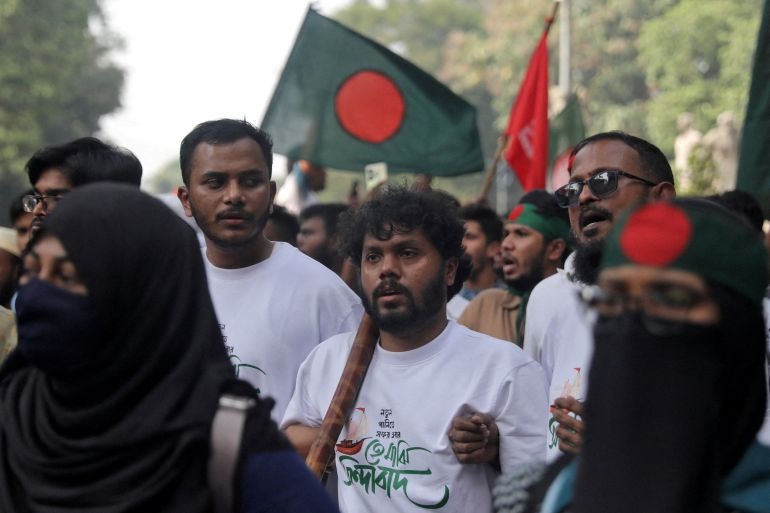
Osman Sharif Hadi, a young, influential Bangladeshi activist, was murdered recently in Dhaka. Being an active member of Inqilab Mancha (Platform for Revolution), Osman played a central role in the August 2024 youth-led pro-democracy protests against Indian backed autocratic regime of Sheikh Hasina Wazed. The deceased was an outspoken critic of India and its regional hegemonic designs. Osman’s confidants believe that India is involved in his murder and even Bangladeshi authorities have claimed that the main culprits behind the murder are in India. The following analysis details India’s extra-territorial and extra-judicial killings and explores whether India has a role in the killing of Osman Hadi.
India has a long record of extra-territorial and extra-judicial killings, while the Hardeep Singh Nijjar murder case is at the top of the list. Hardeep, a Canadian national, was an active member of a Sikh separatist movement, Khalistan. The Indian government was not happy with Hardeep’s ideology and his activism. From 2010 onwards, the Indian government accused him of planning violent activities in India. Even the Indian government officially requested the Canadian government to take action against him. The Canadian government did not take any substantial action against him because of unsatisfactory evidence provided by India. However, in 2023, Nijjar was murdered in a well-planned and well-executed attack. Initially, his close family and friends maintained that it was India behind his murder. A few days later, Canadian Prime Minister Justin Trudeau claimed that his government had concrete proof of the Indian government’s involvement in the murder of Hardeep Singh. Later, the Royal Canadian Mounted Police (RCMP) announced the arrest of three Indian nationals who were also charged with first-degree murder and conspiracy in connection with Nijjar’s murder and the claim made by the Canadian Prime Minister proved right.
Interestingly, a few months after Nijjar’s murder, an Indian intelligence officer, Vikash Yadev, was accused by the United States (US) Justice Department of planning a plot to kill a US Citizen and Sikh separatist activist, Gurpatwant Singh Pannun. India was very much bothered by Gurpatwant Singh and his activism for Khalistan and even requested the American administration to take action against him and his associated organization. However, Washington did not take any action due to a lack of substantial evidence given by New Delhi for the alleged activities. The main mastermind of the plot, Vikash, was an ex-Central Reserve Police Force (CRPF) officer and later joined the Research and Analysis Wing (RAW). He was allegedly working for the RAW along with another Indian national when he planned the murder of Gurpatwant.
Similarly, in January 2024, Pakistan’s Foreign Secretary, in a media briefing, accused India of orchestrating extra-territorial killings of two Pakistani citizens, Shahid Latif and Muhammad Riaz, on Pakistan’s soil. According to Pakistan’s Ministry of Foreign Affairs (MOFA), Indian agents recruited, financed and supported criminals, terrorists and unsuspecting civilians from Pakistan to play defined roles in these assassinations. Pakistan’s foreign secretary told the press that Indian intelligence officers, Yogesh Kumar and Ashok Kumar, planned and executed these murders from a third country. However, Pakistan’s government did not release any details about the murdered nationals.
In the case of Bangladesh, India seeks to maintain its influence over Dhaka primarily due to its easy access to its northeastern states via the Siliguri Corridor, also known as the Chicken Neck. So, New Delhi can effectively curb and counter a large number of long-standing ethnic and separatist movements in its northeast. It is an open reality that India extensively backed Sheikh Hasina’s autocratic regime for more than 15 years and even her predecessor regimes, to smoothly and effectively deal with separatists in its northeast.
Now, after Hasina’s ouster with a widespread youth protest, demarcated forces were becoming strong and anti-India voices were rising in Bangladesh. Elections were announced and Osman was also campaigning for the upcoming elections for a constituency in Dhaka. During his election campaigns, he was very critical of India, particularly against what he characterized as the Indian policy of supporting a non-democratic puppet regime in Bangladesh and having hegemonic designs in the region. He used to frame the struggle for democracy in Bangladesh as being fundamentally linked to the removal of all external influences, specifically of India. Osman was also a strong supporter of Greater Bangladesh, and a few hours before Osman was shot, he shared the map of Greater Bangladesh on his social media platforms. That map showed Indian regions, including West Bengal, Tripura, Assam (especially Barak Valley / Sylhet-connected regions), parts of Meghalaya, parts of Bihar and Jharkhand as part of Bangladesh. In post-Hasina Bangladesh, Osman’s popularity was rising mainly due to pro-democratic and anti-India stance, as it represented the true sentiments of the majority of Bangladeshi people.
Given this momentum, Osman was widely expected to secure a decisive victory in the February 2026 elections. Therefore, a young and popular leader in Bangladesh’s parliament who openly challenged India’s hegemonic and expansionist designs, with support from the masses, would have posed a strategic challenge to New Delhi. The growing anti-India narrative could reduce Bangladesh’s overall political support to New Delhi in the region, as it had already started after Hasina’s ouster. Resultantly, it would have become more challenging for New Delhi to maintain a compelling presence and counter separatist movements in the northeast, particularly when there is little political support from Bangladesh. Moreover, in a press briefing, Bangladeshi police recently claimed that two Indian nationals helped the murderers to cross the border from Haluaghat sector, Bangladesh, into Meghalaya, an Indian state. However, the Indian Border Security Force (BSF) has rejected Bangladesh’s claim. The circumstances surrounding Osman’s assassination warrant closer scrutiny and further investigations are underway as the main culprits behind Osman’s murder are yet to be captured. However, when Osman’s murder is viewed in the context of India’s documented history of extra-judicial and extra-territorial killings aimed at safeguarding perceived national interests. Particularly, given the Indian compulsion to have Dhaka on board to effectively control separatists in the northeast and Osman’s growing popularity, specifically due to Anti-India sentiments. The likelihood of Indian involvement in Osman’s murder becomes stronger.
Fakhar Alam is Research Officer at the Center for International Strategic Studies (CISS) Islamabad.
