



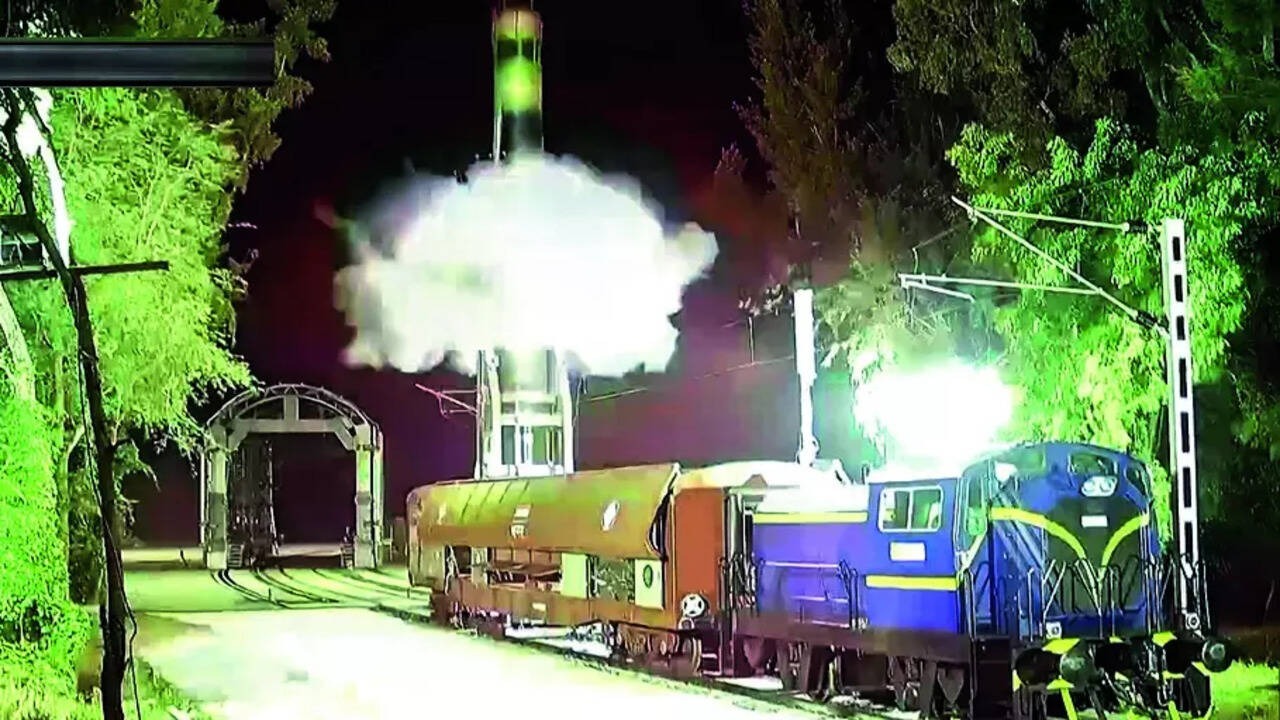
Indian Defence Research and Development Organisation (DRDO), in collaboration with the Strategic Force Command (SFC), has successfully test-fired the Agni-Prime missile from a rail-based mobile launcher. The tested missile could carry a payload to a distance of 2000 kilometers (Km), making it a Pakistan-centric missile system. This article analyzes the technical features of the rail-based Agni-Prime missile to assess its operational advantages. It also explores the implications of those advantages for the strategic stability of South Asia.
This newly tested missile’s most prominent and novel feature is the rail-based mobile launching platform. This provides Agni-Prime with the cross-country mobility of around 70000 Km. Unlike road-mobile systems, a rail-based launcher offers enhanced mobility across the national grid while allowing greater concealment and operational flexibility, particularly under the guise of civilian infrastructure. Therefore, the rail-based mobility factor significantly improves the pre-launch survivability of the deployed system and reduces its vulnerability to an adversary’s attack. However, during the Cold War, mutual vulnerability of strategic assets was considered one of the prerequisites for deterrence stability between America and the Soviet Union. It was a bilateral understanding that the mutual vulnerability of the strategic forces disincentivizes either side from taking bold actions and therefore produces a credible deterrent.
Simultaneously, the press release published by India’s Ministry of Defence (MOD) claims that the recently tested two-staged solid propellant, next-generation, medium-range Agni-Prime is cannisterised. This implies that the warhead will be mated and stored with the missile system; therefore, it will reduce the time required for missile preparation and missile launch, particularly during a crisis. Moreover, the canisterization also indicates the Indian shift towards a hair-trigger alert posture. The hair-trigger alert posture significantly compresses the decision-making time and increases the risk of escalation. It also increases the risks of accidental launch or even rapid missile launch in response to false warnings. In South Asia, where missile flight time is very short and mutually agreed lines of communication are mostly inactive during a crisis, a hair-trigger alert posture could produce disastrous outcomes for crisis stability.
Moreover, the previously tested Agni Prime missile had a dual-redundant navigation and guidance system. However, no information was given regarding the navigation and guidance system of the recently tested version. The dual redundancy of navigation and guidance systems means that in case one of the navigation or guidance systems fails, either due to the system’s failure or by an adversary’s countermeasures, the other navigation or guidance system will continue to guide the missile to its designated target. States invest heavily in improving navigation, guidance, and associated technologies and systems across their missile inventory to achieve pinpoint accuracy and reduce Circular Error Probability (CEP).
Likewise, the earlier tested version of Agni-Prime had 10 meters of CEP, while the CEP of the recently tested rail-based version is not publicly declared by the Indian MOD. However, experts are of the view that it has either the same or less CEP compared to the earlier tested one. A smaller CEP of a strategic asset, enabled by an advanced, state of the art, dual redundant navigation and guidance system, makes it a potential system for precision strikes. Particularly, when India is simultaneously investing heavily in augmenting its intelligence, surveillance and reconnaissance (ISR) capabilities. This precision strike capability, along with rapid deployment capability in a crisis, makes rail-based Agni-Prime a counterforce pre-emption targeting option.
India’s recent test would definitely aggravate Pakistan’s security dilemma. Pakistan, which has faced a conventional asymmetry vis-à-vis India along with a continuous threat of a limited offensive against itself under the nuclear overhang, would feel further threatened by this strategic development. This development might compel Pakistan to take the necessary measures to preserve the regional strategic balance disturbed by India. These measures could be either countermeasures aimed at denying the operational advantages that rail-based Agni-Prime enables India or the development of a similar capability to deter India by re-establishing mutual vulnerability and reciprocal deterrence. Therefore, this test has equal potential to augment a new arms race as well in South Asia.
Traditionally, the deployment of rail-based launch systems was aimed at strengthening the country’s second-strike capability. During the Cold War, it was the Soviet Union that, for the first time, deployed a rail-based launcher capability. Later, America also started the project for its rail-based launching systems. In contemporary times, along with the US and Russia, only North Korea and now India have officially declared rail launch capability. Moreover, the press release clearly says that the successful launch from a rail-based system has paved the way for the integration of other missile systems with a rail-based launching system. Therefore, India might soon integrate and test fire some other nuclear-capable missile systems from a rail-based launcher, which would create further challenges for the region. South Asia’s strategic stability is already under grave stress and demands more transparency among nuclear armed adversaries through Confidence Building Measures (CBMs). The May 2025 crisis has already unfolded that the region lacks active crisis management mechanisms. This crisis has also revealed that within a few hours, two nuclear-capable neighbors could resort to nuclear weapon use, and the bilaterally decided communication channels are not activated until intervened by a third party. In such an environment, testing of a rail-based launcher increases the trust deficit, demands countermeasures, challenges crisis stability, undermines deterrence stability, which all in turn produce challenges for the strategic stability of South Asia.


Fakhar Alam is Research Officer at the Center for International Strategic Studies (CISS) Islamabad.