

The Indian Ocean holds a significant position in maritime history and contemporary global makeup. It is landlocked by three sides, with favorable wind currents, important straits, and distribution of islands and archipelagoes. Humanity’s first oceanic activities began in the Indian Ocean. This region has been a hub of trade and strategic interest. In today’s globalized and interdependent world, the Indian Ocean, especially from the Horn of Africa in the north and to the Strait of Malacca in the east, connects the east and west through important sea lines of communication (SLCOs). With massive quantities of crude oil shipped from Arabian Peninsula to the countries in the east and southeast Asia through narrow chokepoints such as Bab el Mandeb, Hormuz and Malacca. Similarly, around fifty percent of the world’s container traffic are passing through its waters, making the Indian Ocean as one the most important maritime routes for world commerce. However, this sensitive strategic position has also rendered the region vulnerable to many problems like piracy, human and drug trafficking, and other maritime domain crimes. Moreover, it has resulted in competing strategic interests and rivalry among regional and extra-regional navies, making maritime security one of the most important issues requiring attention.
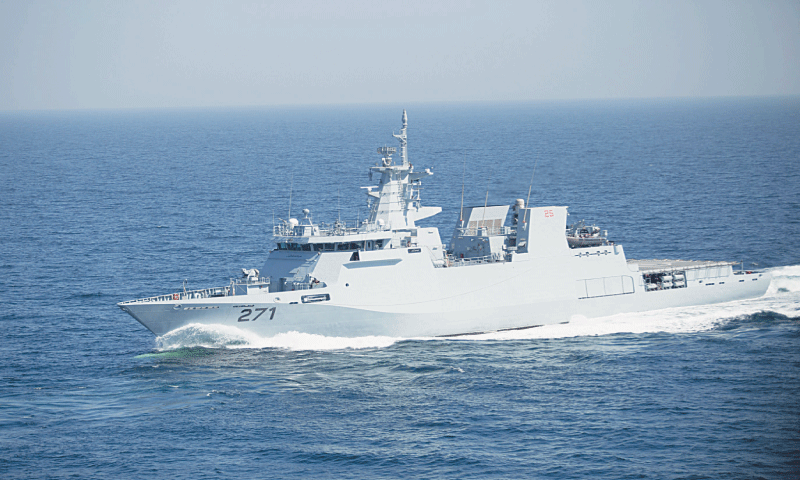
Pakistan, being situated near some of the busiest Sea Lines of Communication, with an economy heavily dependent on maritime trade, is an important country in the region. The country’s significant strategic assets, including CPEC projects and the operational Gwadar Port, necessitate the provision of security to its maritime domain. This further increases the responsibilities of the Pakistan Navy. The Pakistan Navy’s approach towards maritime security challenges has remained collaborative, with its contributions extending across multiple facets of the maritime domain. Through participation in international peacekeeping missions and the initiation of various national-level initiatives, the Pakistan Navy has defended Pakistan’s maritime borders and played its role as an enabler of regional security cooperation against common threats to maritime commerce in the region.
To help counter maritime terrorism, the Pakistan Navy joined the US-led Combined Task Force 150 (CTF-150). The task force continues to work collaboratively with regional navies, and by completing ten command tenures, the Pakistan Navy has demonstrated its steadfast commitment to fulfilling its international obligations. Since 2005, modern-day piracy near the Horn of Africa has wreaked havoc, causing immense damage to maritime trade activities. In response, the Coalition Maritime Forces Headquarters in Bahrain established Combined Task Force 151 (CTF-151) to counter the menace of Somali piracy. Through commanding CTF-151 on multiple occasions, the Pakistan Navy has demonstrated its firm resolve and commitment to preserving maritime security in the region.
Another important maritime security initiative undertaken by the Pakistan Navy was the establishment of the Regional Maritime Security Patrols (RMSP) in 2018. This initiative provides a platform for regional navies to work collectively, offering opportunities to reduce their dependence on extra-regional powers and promote regional maritime security. In the past, several security initiatives have resulted in tensions and mistrust among regional countries. A unique feature of RMSP is its region-centric approach towards achieving strategic autonomy. This platform has served as an important enabler for regional navies to develop a collective resolve against maritime domain crimes, including piracy, terrorism, and human smuggling.
One of the most significant initiatives undertaken by the Pakistan Navy was the launch of Exercise AMAN in 2007. Conducted biennially, it is a multilateral naval exercise that brings together navies from different countries under the slogan “Together for Peace”. The core objective of these multilateral exercises is to enhance cooperation and interoperability among regional and extra-regional navies in the Indian Ocean.
Aiming to develop a collective resolve against traditional and non-traditional threats, Exercise AMAN has emerged as a trendsetter in the region. The exercise comprises two phases: an International Maritime Conference, followed by operational exercises involving different modules and activities. Through Exercise AMAN, the Pakistan Navy has provided an intellectual and operational platform for navies from different countries to collectively address maritime security challenges. Moreover, the continuously increasing number of participating navies and observer states over the years demonstrates how Exercise AMAN has evolved into a shared platform for extra-regional powers to come together for a common purpose.
Marine pollution resulting from harmful anthropogenic activities is a global phenomenon, and Pakistan is no exception. Massive petroleum spills into the ocean, unreported and unregulated fishing, diminishing vegetation along coastal areas, and the introduction of industrial waste and pollutants into the ocean have caused irreversible damage to the marine environment. The Pakistan Navy has launched various awareness campaigns to sensitize the public and relevant stakeholders. By undertaking remedial measures to reduce pollution in coastal areas, launching a massive campaign to revive diminishing mangroves along Pakistan’s entire coastline, and establishing a dedicated environmental organization under the Directorate of Maritime Affairs and Environment Control, the Pakistan Navy has made every possible effort to protect the country’s marine environmental assets. As the nature of maritime security challenges in the region extends beyond the capacity of any single state to address, effective governance and the provision of necessary security across the vast expanse of the ocean require collaboration and collective efforts to protect vital trade routes. In this regard, the Pakistan Navy has fulfilled its international obligations and, in a region characterized by alliance formation and military posturing, has continued to promote collaborative approaches towards maritime security.

Dr Maira is a Senior Research Fellow at Maritime Centre of Excellence, Pakistan Navy War College, Lahore, Pakistan.

