

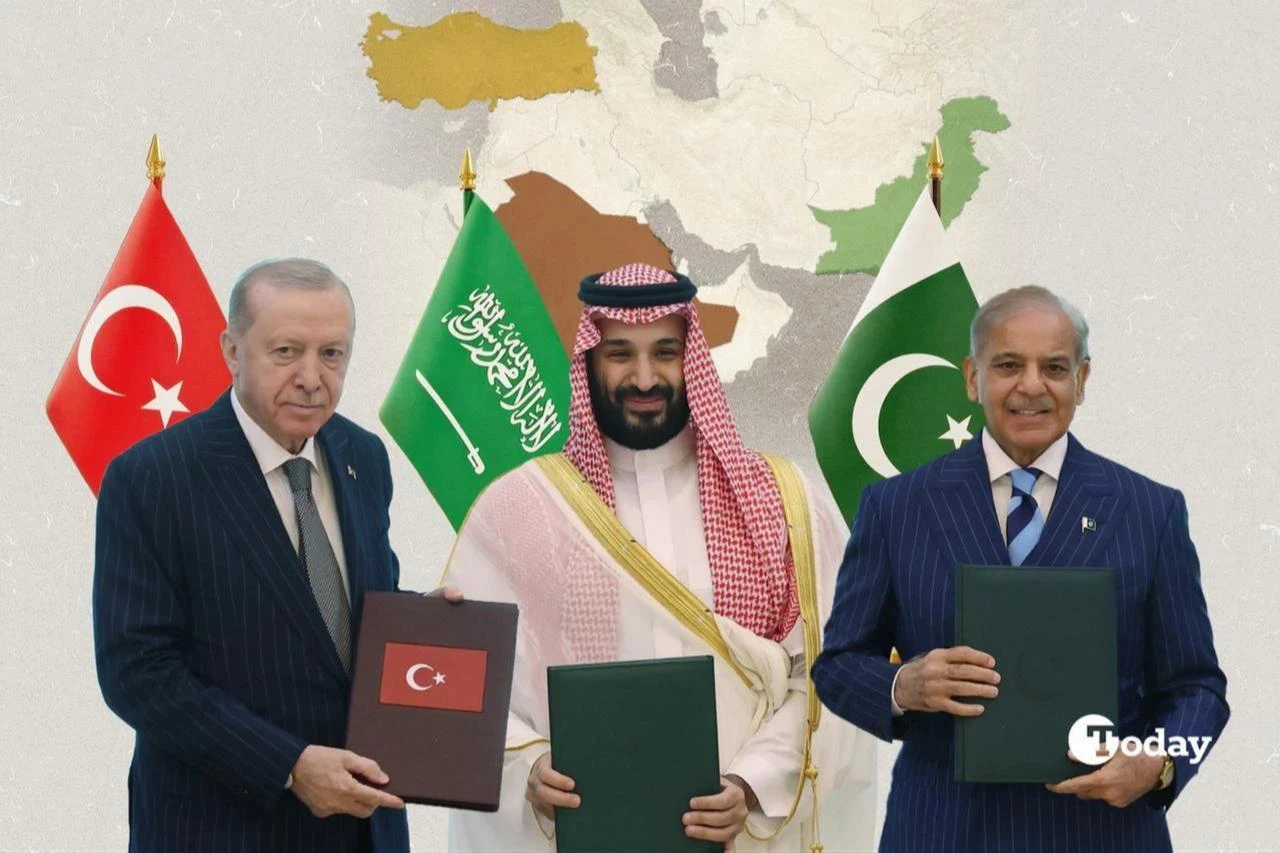
The Makkah Joint Defence Agreement, which was signed under Saudi Arabia, Türkiye and Pakistan on 7 August 2026, is a pivotal step towards enhancing security cooperation in the region. The pact stipulates that an attack on one member will be considered an attack on all and likewise heightens defence cooperation among the members. The deal has significance beyond just symbolism. It is a gesture of a new initiative towards establishing more regionally grounded security architecture, which would link South Asia and West Asia.
From Bilateral Ties to Trilateral Cooperation
The deal isn’t a trilateral treaty; it is a formalisation of a relationship. Pakistan, Saudi Arabia and Türkiye have had very strong defence relations but mostly on a bilateral basis. In September 2025, Pakistan and Saudi Arabia officially strengthened their ongoing defence alliances with the signing of the Strategic Mutual Defence Agreement (SMDA), pledging to treat an attack on one country as an attack on both. In addition, Saudi Arabia and Türkiye have steadily been developing their bilateral defence cooperation, such as defence industry cooperation, research and development, technology transfer and production. This cooperation was further strengthened in 2025 with further high-level defence activities and contracts between Saudi and Turkish defence corporations.
The Strategic Mutual Defence Agreement (SMDA) between Pakistan and Saudi Arabia in 2025 has enhanced the longstanding and extensive defence relations between the two nations. The Makkah Agreement takes this rationale forward to a trilateral agreement, formally involving Türkiye.
Especially Türkiye is playing a prominent role. Ankara has been active recently in the regional security arena and has significant defence relations with both Islamabad and Riyadh.
The trilateral coordination is one of the important components of this agreement. It opens the way to interoperability, information exchange, mutual training and cooperation in the defence industry.
Collective Defence and Deterrence Logic
The most significant element of the agreement is the collective defence agreement: If one member is attacked, it is an attack on all three members. The concept is to increase the possible costs of aggression, thus increasing the deterrent effect. The state that wishes to take hostile action now has to ponder a joint effort by three crucial countries, under which an attack on one would be considered an attack on all three.
But deterrence requires more than just words; it requires credibility. The true challenge will come when the three States can establish processes for cooperative planning, intelligence sharing and action during crises. If there is a lack of institutional depth, the agreement may be ‘symbolic ‘ and ineffective
Not a NATO-Style Alliance
The agreement is similar to NATO’s Article 5, but only to a certain degree. NATO is a well-institutionalised alliance, having interwoven command structures and procedures. Unlike NATO, the Makkah framework does not yet have comparable institutional structures, integrated command arrangements, or established procedures for collective action. The issue is not, then, whether the agreement is like NATO, but whether it can act as a viable regional security mechanism that can fit the local geopolitical situation.
Implications for Pakistan
The agreement is significant strategically and diplomatically for Pakistan. It could expand Pakistan’s strategic engagement beyond South Asia and deepen its role in wider Middle Eastern security affairs. Pakistan already enjoys good defence ties with Saudi Arabia and is has strong defence ties with Türkiye. The trilateral mechanism brings these interrelationships together under one roof, thus enhancing cooperation with two major partners.
Diplomatically, this boosts the image of Pakistan as a country which is able to contribute to regional stability without becoming formally aligned with competing regional blocs. This is especially crucial in the context of Pakistan’s efforts to maintain a balance in its relationship with other regional partners.
Meanwhile, the participating states want this framework to be defensive. It must not be seen as a part of a bloc against any given country.
Regional Implications
The agreement is a sign of a change in security thinking in the region, particularly in the Gulf, where countries are seeking to diversify their security relationships. The pact is a boost to Saudi Arabia’s relations with two key Muslim nations capable of sharing their defence capabilities with the Kingdom. For Pakistan and Türkiye, it is the beginning of a new role in Gulf security where they are seen as a security provider and new stabilisers.
In terms of geographic location, it connects South Asia, the Gulf and Türkiye, creating a newly formed strategic alignment having implications on Gulf, South Asian and Middle Eastern security.
From Commitment to Capability
The greatest challenge remaining is how this will be implemented. The real utility of the agreement will follow by implementing the political will in the operational arena, by carrying out joint exercises, sharing intelligence, planning defence and taking joint action during crises.
There could be a major factor of cooperation in the defence industry as well. The defence industry has already been a field of cooperation between Pakistan and Türkiye, and Saudi Arabia is moving towards more defence localisation. The agreement could be further strengthened in terms of its practical value if advanced defence technologies are further developed.
But it will take continuous political will for institutionalisation. Non-automatic coordination will result from differences in geography, threat perceptions and strategic priorities. A flexible structured framework will thus be required to address these differences.
A Beginning, not a Finished Alliance
The Makkah Joint Defence Agreement should therefore be viewed as the beginning of a more structured framework for regional security cooperation rather than as a fully developed alliance. It could, if it is well applied, be a basis for a more regionally based security architecture; otherwise, it could remain politically valuable and operate in a limited way. The potential for Pakistan is in strengthening strategic relations while also making sure that it does not lead to the formation of blocs, but to stability. The agreement is an expression of a regional shift in thinking; the inclination by the regional states to take more responsibility for themselves. It’s not clear if it will become a more permanent security system. But it does raise one important question for the region and for Pakistan to consider: Can greater regional ownership of security contribute to a more stable regional order, and what role can Pakistan play in shaping it?

Ms Shahwana Binte Sohail is Research Assistant at the Center for International Strategic Studies (CISS), Islamabad.
