

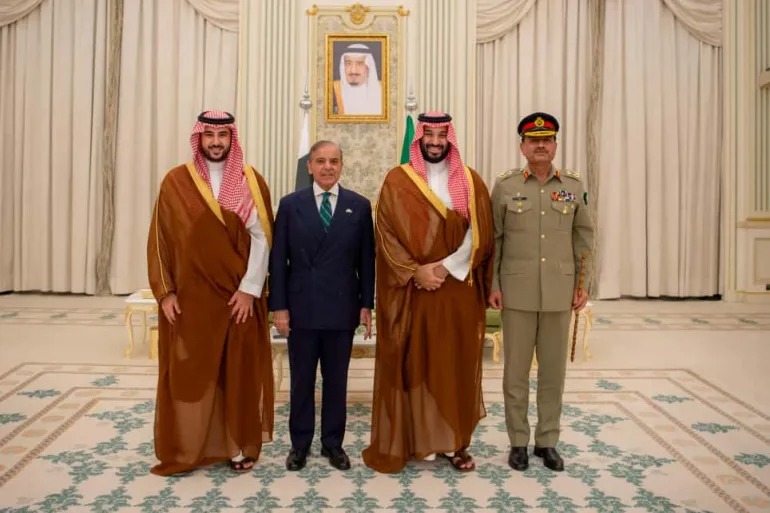
In a significant development, on 17 September, Pakistan and Kingdom of Saudi Arabia (KSA) signed a Strategic Mutual Defence Agreement (SMDA). The agreement attracted media spotlight, purportedly publicising that nuclear-armed Pakistan is going to provide security to KSA. In a statement released by the PM Office of Pakistan, the pact stipulates “any aggression against either country shall be considered an aggression against both, without referring anything regarding a nuclear cover.” However, soon after the agreement, a wave of argument surfaced in Western media that Saudi Arabia, without developing nuclear weapons, got one, and Islamabad is providing a nuclear umbrella to Riyadh.
This claim has no credible basis. Pakistan has only developed nuclear weapons, as necessary, for its own defence and solely to deter its arch-rival India. Furthermore, Pakistan has neither the ambition nor the capacity to provide extended deterrence to Saudi-Arabia. Extended deterrence comes with certain requisites that require forward deployment of forces, command structures, and exercises that demonstrate force readiness. To provide extended deterrence to Saudi Arabia, Pakistan lacks these essential components of extended nuclear deterrence abroad. Pakistan is thus not likely to provide a nuclear umbrella to Riyadh or any other country due to these reasons.
The signed pact can be best understood as an institutionalisation of already existing security relationships between the two countries, rather than a response to current developments in the region. Officials in both states have clearly stated that the SMDA culminated as a result of years of dialogue, and that “it is not a response to specific countries or specific happenings.” Along with that, Pakistan and Saudi Arabia have had historic defence cooperation since the 1960s. Pakistan has trained more than 82,000 Saudi armed forces personnel, and both sides have held various joint military exercises since then. Throughout the 1970’s 15000 Pakistani troops were stationed in the Kingdom. Furthermore, the Afghan war witnessed the peak of Pakistan-Saudi defence ties, which culminated in a historic protocol agreement, signed between Saudi-Arabia and Pakistan. King Faisal then openly admitted that, “the Kingdom’s security is tied to Pakistan,” during his visit to Islamabad in the 1980s. It illustrates that Pak-Saudi defence cooperation is not new; rather, it is a decades-old defence relationship involving joint military exercises, training of personnel, and much more.
For extended deterrence, Pakistan lacks a permanent force and has no such forward-deployed bases in the Gulf region. Moreover, Pakistan’s nuclear doctrine is solely India-centric and only designed for deterring a conventionally superior aggressor in the neighborhood. It is not designed for extending deterrence to third parties, anywhere in the world. Pakistan’s nuclear posture is designed to deter Indian conventional and nuclear aggression. So, the logic of extended deterrence does not fit into an operational commitment to protect Saudi Arabia, nor does Pakistan have any declaratory policy, peacetime planning, or signaling that extended deterrence normally requires.
Moreover, Pakistan does not possess the enabling systems or any infrastructure in the Gulf that could add credibility to extended deterrence in times of crisis. Extended deterrence relies on integrated nuclear command, control, and communications, timely warning, and integrated planning cycles with the host state. Therefore, replicating the architecture that the United States built with NATO allies would require years of investment and intimate integration with host state command networks that simply do not exist in the case of the Pakistan-Saudi equation. In any case, Pakistan’s nuclear program is not geared to provide nuclear cover to any other country.
In contrast, NATO’s extended deterrence works because the United States has stationed its forces in the European theater and institutionalized the defence commitment through Article 5 of the NATO charter. The United States, through these measures, tied its own security with the security of its allies. Under this provision, it became obligatory for the US to fulfil its commitment to its allies. Although the Pakistan-Saudi Defence Pact sounds like NATO Article 5, but it actually does not have a binding nuclear sharing arrangement with the KSA. The clause that an attack on one country will be treated as an attack on both is politically significant, yet it does not convert Pakistan and Saudi Arabia into a integrated command. Moreover, in the event of conflict, each state would respond in its own capacity, whether diplomatically, economically, or militarily. Early official characterizations from Islamabad have indeed described the arrangement as a defensive concept, rather than as an offensive commitment or an automatic war-fighting plan.
Furthermore, the United States model of extended deterrence succeeded in Europe because the US shared an alliance with most of the European states, and placing of nuclear weapons, does not alarm other European partners. On the other hand, if Pakistan deployed its nuclear forces in the Middle East’s adversarial alignments, it would most likely be interpreted as a direct security threat to other regional countries.
One of the main contours of extended deterrence is the placement of nuclear assets in host states, for instance, the US placement of weapons in NATO states and the Russian placement of some of its tactical nuclear weapons in Belarus. Keeping in view this, the Saudi-Pakistan defence pact does not explicitly mention any sort of nuclear sharing cooperation, nor does Pakistan offer its nuclear deterrence to Riyadh. There is no reasonable prospect that Pakistan would position its nuclear weapons outside of its territory. States that are protected by a nuclear umbrella, rely on decades of codified planning, dedicated formations, specialized basing infrastructure, and painstakingly negotiated legal arrangements, often within alliance frameworks. In comparison with NATO’s nuclear sharing involves dual-capable aircraft, U.S. custody of nuclear arsenal and operational controls, standardized exercises, and a political consultative machinery that is integral to the credibility of extended deterrence abroad. In contrast, Pakistan and Saudi Arabia have none of these features in place. In short, Pakistan cannot provide extended deterrence. Also Pakistan’s doctrine is solely India-centric; it has institutions with centralised decision-making for national security needs, not for fulfilling allied requirements outside of its territory.

Ms Sana Ahmed is a Research Associate in Islamabad-based independent think tank (SVI).
