

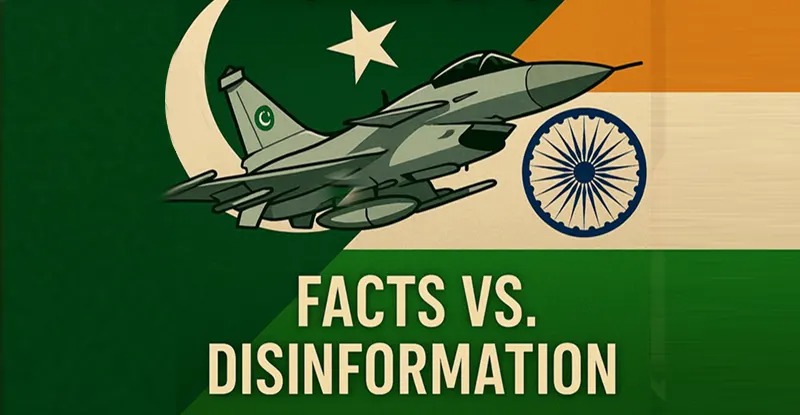
As the saying goes: “The first casualty of war is truth.” This was painfully evident in India’s media theatrics during the May conflict. The May 2025 conflict wasn’t just about missiles and jets—it was about legitimacy, perception, and strategic credibility. Pakistan succeeded where it mattered most: in the realm of truth, restraint, and global persuasion.
The EU DisinfoLab once noted: “Disinformation is the new terrorism.” Just as terrorism seeks to terrorize societies into submission, disinformation aims to fracture truth, trust, and public unity
Information warfare—the use of lies, manipulation, and psychological tools to influence perception—isn’t new. Joseph Goebbels, Minister of Propaganda of Germany, controlled media, film, and art during the Second World War and promoted Aryan supremacy and anti-Semitic narratives. But the India–Pakistan crisis of May 2025 may well become a textbook case in how this weapon can backfire. From psychological operations and disinformation to AI-generated propaganda, the four-day escalation turned Indian media into a frontline actor.
Indian mainstream media, often dubbed “Godi Media,” became the propaganda engine of war. ABP Ananda aired a 37-second clip from a 2021 plane crash in Philadelphia, presenting it as evidence of a strike on Karachi.
Zee News and Times Now Navbharat falsely claimed Islamabad had fallen, Pakistan had surrendered, and the military had collapsed. One particularly surreal report declared INS Vikrant had reached Lahore—a landlocked city hundreds of miles from the sea.
Some of these broadcasts were reportedly driven by an internal Prasar Bharati directive—India’s public broadcaster—falsely claiming that Pakistan’s Army Chief had been arrested in a coup. No such event occurred.
Other channels like Republic TV, India TV, and Times Now promoted recycled visuals and deepfakes claiming Pakistani jets had been downed and pilots captured in Jammu and Kashmir—claims the Indian Army itself later denied.
Were all these blatant lies and cooked up breaking news aimed to bolster national morale or race to secure highest rating or above all over reaction to cover up the downing of multiple Indian aircrafts in opening phase of kinetic operation between India and Pakistan?
India’s media spectacle wasn’t random; it was a coordinated narrative campaign. Cognitive warfare, the manipulation of public perception, was central to India’s strategy. Using AI-generated visuals, psychological tactics, and misinformation targeting military families and social media users, India attempted to control the war narrative at home and abroad. This was abundantly clear from Indian leadership’s rhetorics backed by Indian frenzy media reporting soon after Pahlgam incident.
Animations showed Pakistani flags burning. Fake geotagged data was sent to embassies and multilateral organizations. AI tools pushed demoralizing alerts about fuel shortages or imaginary bombings. But the reliance on drama rather than discipline quickly undermined credibility.
In contrast, Pakistan’s response was grounded in doctrine, not drama. DG ISPR Major General Ahmed Sharif Chaudhry made a telling statement:
“When Pakistan responds, the entire world will see it — there will be no need for any media outlet to explain it.”
That was no bluff. While Indian anchors role-played military analysts, Pakistan pursued a doctrinally sound, measured, and digitally empowered strategy. It conducted precision strikes, avoided escalation, and maintained tight control over official messaging.
Rather than public grandstanding, Pakistan leveraged its “Digital Kill Web”—an integrated cyber-EW-kinetic framework—to disrupt Indian assets and maintain battlefield superiority.
Despite the scale of the information war, the United Nations lacks a dedicated mechanism to address information warfare as a standalone threat.
UNESCO plays a limited role, focusing on cognitive resilience, media literacy, and counter-disinformation education. The UN Human Rights Council condemns state-sponsored disinformation as a human rights threat, but enforcement is weak.
In July 2025, the UN Open-Ended Working Group on ICTs recommended establishing a Global Mechanism to address digital threats—including information manipulation. While promising, it remains in early stages.
Pakistan has the opportunity to lead on this front by advocating for a UN-mandated Code of Conduct on Responsible Information Behavior During Conflict, Real-time Fact-Verification Missions during crises and a Global Repository of Conflict Disinformation Sources, potentially naming and shaming repeat offenders—like India’s state-media ecosystem.
International analysts increasingly aligned with Pakistan’s restrained, evidence-based approach. U.S. experts noted that Pakistan shaped the global narrative early, while India’s delay allowed others to frame it as the aggressor.
Pakistan lifted social media restrictions and briefed foreign outlets. India, in contrast, blocked thousands of accounts, silenced critics, and pushed state-run disinfo.
India’s disinformation campaign may have stirred temporary euphoria, but in the long run, it exposed the fragility of a system addicted to drama over discipline. For Pakistan, the real victory lay not in retweets or ticker headlines, but in turning back propaganda with professionalism—and doctrine.
India also left the recent SCO meeting “red-faced”, lacking support from other member states for its terrorism narrative. It also did not sign the joint communiqué after member states refused to include any mention of the April 22 Pahalgam attack, Pakistan believes that in times of tension, true strength is shown not through loud claims or theatrical displays, but through thoughtful action, composure, and responsible leadership. While others chose chaos and confusion to influence global opinion, Pakistan upheld dignity and discipline, earning respect through quiet confidence. In defending truth, Pakistan did not just win the narrative—we upheld the very principles of international peace and responsible statecraft. The world must not be misled by fabricated triumphs or AI-generated lies. It is now essential for the global community to recognize the rising threat of digital deceit and craft international safeguards to protect facts, trust, and stability. Pakistan stands ready to contribute to such efforts, not as a victim, but as a proactive voice for justice, balance, and truth in global affairs. Our message to the world is clear: real credibility cannot be fabricated—it must be earned through honesty, maturity, and unwavering responsibility.

The writer is an independent security analyst.

