

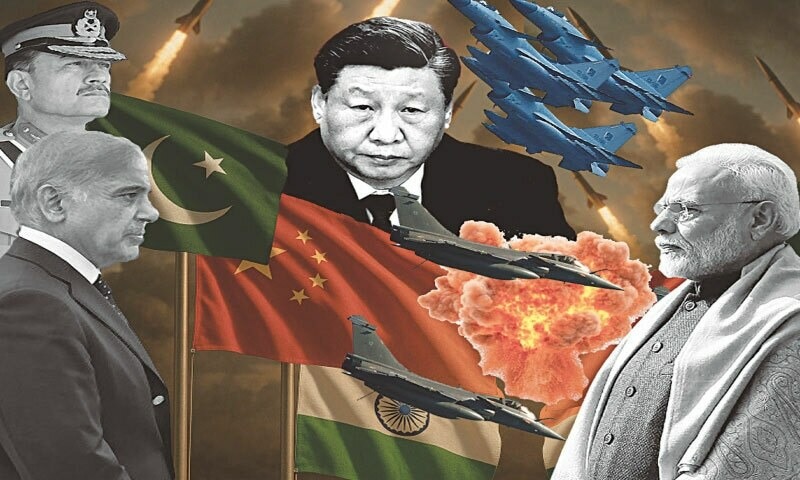
Regional security will no longer rely on the numerical value of the arsenal; rather it will be systematically shaped by the adaptability of relative strategic rivals to a rapid, more sophisticated and technologically entangled deterrence environment. This defines the emerging deterrence model based on three core characteristics: escalation would be faster, non-linear and less manageable; there is risk of inadvertent nuclear escalation; and third-party intervention becomes structurally compelled feature. It means that enduring stability must be a deliberate construct, instead of merely a delusion of international relations post-Cold War.
Can nuclear powers fight conventional wars with each other and avoid the use of nuclear weapons? This dilemma of deterrence in Barry Posen’s enquiry into ‘Inadvertent Escalation’ acquires profound relevance in South Asia’s emerging deterrence model. The nature of escalation, as assumed traditionally, has significantly changed in the South Asian deterrence equation. Though previously as well, the preserved deterrence stability in South Asia offered a case study of how deterrence actually upholds between two nuclear armed neighbors. The recent crises in 2025 between Pakistan and India foregrounded certain new features which may become potential trends in the deterrence framework in future. First, they reemphasize the fact that there would always remain risks, not space, for limited conventional conflict under the nuclear overhang. It does not indicate any deterrence failure or allow assuming false confidence of not to be deterred. Deterrence exists with its inherent ‘ifs’ and ‘buts. If two states are nuclear armed, it is imperative for them to be prevented or influenced by deterrence. In case of South Asia, deterrence became operational once India and Pakistan successfully tested their nuclear weapons. Second, outside the traditional paradigms, the characteristics of deterrence including gradual crisis escalation along the escalation ladder, clear thresholds, and predictable signaling, have been outmoded by the emerging deterrence model. This emerging deterrence model obligated the prompt intervention of the US to avert the cascading crisis between India and Pakistan. Therefore, the unfolding nature and pace of escalation in South Asia must re-establish the narrative that both India and Pakistan must be deterred, irrespective of any ambiguities in asymmetry or nuclear thresholds.
While in certain contexts, numerical superiority of arsenal and composition like dual-capability and stockpiles may have psychological effects. In case of Pakistan, the Credible-Minimum-Deterrence clearly outlines primary consideration of qualitative approach to deterrence to manage any asymmetry with nuclear adversary. Therefore, any perception of either state that it must not be deterred due to perceived edge in terms of size of arsenal or rapid testing of long range delivery means or other quantitative inputs does not diminish the fact that in the India-Pakistan equation and with India’s conventional superiority, Pakistan has achieved nuclear triad with air, land and sea-based nuclear weapons capabilities. Pakistan’s sea-based nuclear weapons such as Hangor-class submarines are going to be significant addition. The Hangor-class is based on AIP technology, and the lethality of this technology is a global realization. They are cheaper as compared to the expensive nuclear fleet and therefore suit Pakistan’s constrained affordability, suitable for littoral operations since Pakistan has no global ambitions like India, also require no nuclear speed/endurance since Pakistan’s nuclear weapons are only India centric. Thus, Pakistan is equally strengthening its nuclear triad by advancing in qualitative deterrence capabilities within the limits of its nuclear doctrine and purpose. It reassures the resolve and credibility of Pakistan’s nuclear weapons, under prevailing asymmetry.
Even the doctrinal evolution demonstrates the operational testing of reciprocal capabilities and the resolve to retaliate in kind. Starting with the Cold Start doctrine, to the surgical strikes and now employment of the counterforce strategies, such periodic episodes of limited-conflict below the nuclear threshold signal India’s attempt to communicate India’s immunity to deterrence. However, Pakistan has also sought strategically corresponding adaptability by its ‘full-spectrum deterrence posture’ and thereby has also proven its conventional deterrence during 2019 as well as May 2025 crisis. The signaling seems to have been well-received by India and therefore, it restrained from triggering the Delhi terror incident in November into another May-kind of crises with Pakistan despite the policy guidelines issued by Modi according to which any future act of terror in India will be considered an “act of war” against India and will be responded accordingly.” Also, the establishment of the integrated command under the office of the Chief of Defence Forces (CDF) seems to have been well-understood by the Indian leadership to determine the changing nature of escalation potential in South Asia. This shows that strategic and psychological effects of deterrence in the South Asia remain intact despite the political impression of any alleged weapons superiority. Misinterpretation of risk with space for limited conventional war under the nuclear overhang seriously challenges the rationality of the caretakers of the nuclear weapons. There is a need for cautious rationality in dealing with deterrence affairs in South Asia because its security environment is evolving with shortened decision-making windows, increasingly ambiguous operational domains, and qualitatively and quantitatively strengthening weapon capabilities, particularly canisterised weapons, precision-guided missile and dual-use missile systems which create probability for preemption in crises. It necessitates reassessment of the ways of conceptualizing mutual deterrence stability, crises escalation and management, and most importantly nuclear signaling. Moreover, the normalization of the notions of coercive signaling, such as the launch of dual-capable Brahmos kind of weapons in crises under nuclear overhang, is a bad idea and reflects the Indian leadership’s entices and nothing else. With ineffective regional structured communication mechanisms, crisis protocols, or de-escalation frameworks, misinterpretation of the threat and inadvertent escalation is a predictive feature and therefore immediately compels international intervention. It must not be misinterpreted as conveying any false confidence that in a nuclear calculus, numerical expansion and any symbolic capability demonstrations provide a state with immunity from deterrence.

Komal Khan is Research Officer at Strategic Vision Institute, Islamabad. Author also served as visiting faculty member at various universities in Pakistan.

Muhammad Abubaker is Research Associate at Strategic Vision Institute, Islamabad.
