
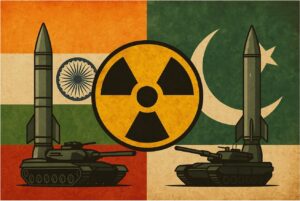


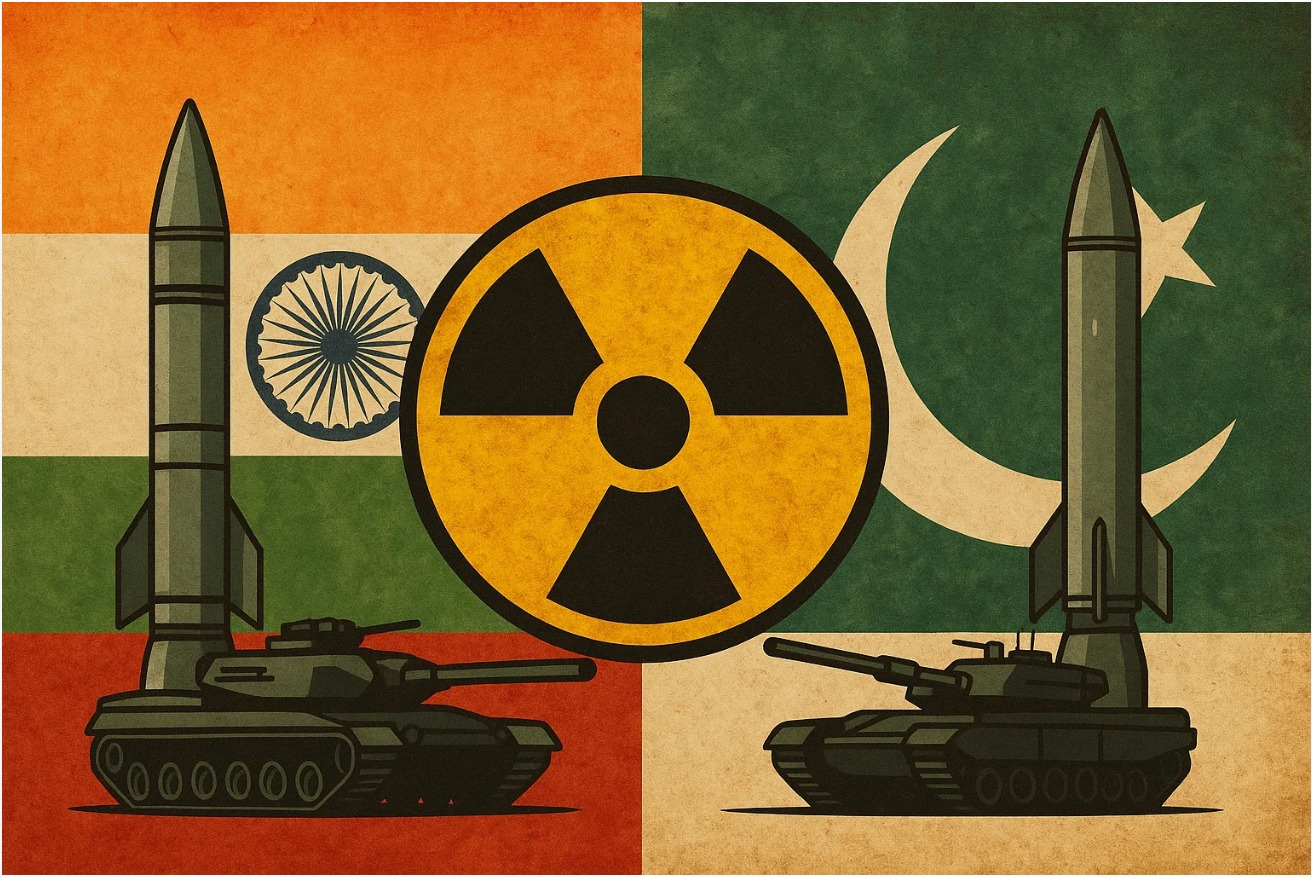
Pakistan and India are the neighboring states distanced by a missile flight time of less than three minutes. Unlike the Cold War equation, which took decades to establish mechanism for strategic restraint and crisis management, South Asia does not have the luxury of time. South Asia’s central problem refers to the growing asymmetry in conventional and strategic weapon, led predominantly by India. In today’s global strategic calculus, South Asia is known to be the only region where the two nuclear powered state, Pakistan and India, share a history of direct military confrontation, active boarder, and unsettled territorial disputes.
Unlike the Cold War adversarial format, India and Pakistan are the neighboring states with flight times of less than three minutes. The risk of miscalculation and inadvertent escalation in South Asia during crisis are highly concerning, considering not only the existing capabilities but also the adjustment of emerging technologies (AI, and the offensive Cyber technology) in the equation. In that context, it is not just central to a technical debate, but it demands assessing how much decision-making time a leadership would have during crisis. It is essential to evaluate how hypersonic systems, MIRVs, artificial intelligence, and cyber technology influence credibility, sufficiency, stability and communication of nuclear deterrence
South’s Asia deterrence is shaped by the Pakistan-India dyad. There is no other dyad that affects the deterrence stability in South Asia. China case is not directly relevant in this equation despite having territorial conflict with India. In that context, the nuclear trilemma is not central to the strategic stability of South Asia. India is heavily investing in conventional counterforce capabilities, particularly through its dual-use delivery systems. For instance, India has carved out the land, aerial, and sea version of the BrahMos cruise missile with the help of Russia, as well as the hypersonic version of BrahMos and integrating them to its Strategic Forces Command (SFC). The dual nature of this missile, whether they are conventional or strategic, cannot be differentiated by targeted country. Similarly, India integrated multilayer air defense system equipped by S-400, and Project Kusha and its MIRV technology demonstrated through the Agni-V test, reflects phenomenal advancement in India’s counterforce first strike capability.
The gravity of the problem resonates when these technologies integrate with AI and cyber technologies. The May 2025 case study showcased how military strikes, AI, cyber activity, disinformation, and advanced missile and surveillance system can operate hand in glove and increased the risk of miscalculation. The major concerns are the integration of these technologies into one system and their effect on strategic stability. Pakistan has not matched the India’s increased military technology to mitigate the risks. Pakistan always believes in the credible minimum deterrence under the umbrella of full spectrum deterrence without signing up to costly technological race. In fact, it is a one-sided recalibration of the South Asian environment by India.
Technological credibility should not be assessed by symmetry of weapons, but by ensuring that a state retains an assured capability to retaliate. Pakistan credible minimum deterrence has always based on the core principle of assure and credibility, not size. On other hand, India’s ICBMs, hypersonic system and cruise missile capabilities, and precision strike has weakened the strategic stability in South Asia and raised the question of vulnerability of Pakistan’s second-strike incentives. Similarly, India has modernized its military capability across land, air, sea, and cyber domain, whereas Pakistan has never attempted to follow the suit. Pakistan believes that capability that ensures credibility is sufficient, irrespective of its quantity. The problem is that India’s consistent expansion of its conventional and strategic arsenals may compel Pakistan to reassess the scale of “Sufficiency”.
The mating of emerging technologies with conventional and strategic offensive capabilities has weakened the strategic stability of South Asia. For instance, the dual use system of India can be equipped with both conventional and strategy payloads, increasing the risk of miscalculation and inadvertent escalation. Similarly, hypersonic system cannot be intercepted because it does not give time to identify and respond by the targeted state. Likewise, the canisterised and pre-mated systems, integrated with AI and cyber systems, could further shorten the decision-making time. It had been demonstrated in the May 2025 crisis between India and Pakistan that how these advancements had enhanced uncertainty and created greater risks of miscalculation.
Another important element is communication, which is essential when new technologies make the state incapable of assessing the enemy’s intentions. Pakistan has supported the 2024 blueprint for Action on military use of AI and endorsed human control over decision pertaining nuclear weapons as well as calling for the global regulatory framework on Lethal Autonomous Weapons System (LAWS). Whereas India has not supported any of the AI regulatory frameworks. Pakistan has never responded to India with a system for system competition but has maintained its own approach to AI governance. It demonstrates Pakistan’s deliberate effort to preserve stability without entering technological race. The deterrence in South Asia has weakened due to India’s conventional, nuclear, maritime, and technological modernization very rapidly. Its behavior from Kargil conflict in 1999 to May 2025 stand-off has consistently demonstrated India’s firms believe that the conventional campaign is a rational choice under the nuclear overhang. However, each conflict has turned both the nuclear armed states dangerously close to the nuclear threshold. South is the world’s highly sensitive nuclear flash point, bearing no space for error and adventurism.

Murad Ali is a Research Officer at the Center for International Strategic Studies (CISS), Islamabad.


