

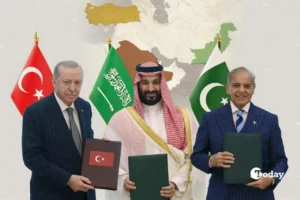


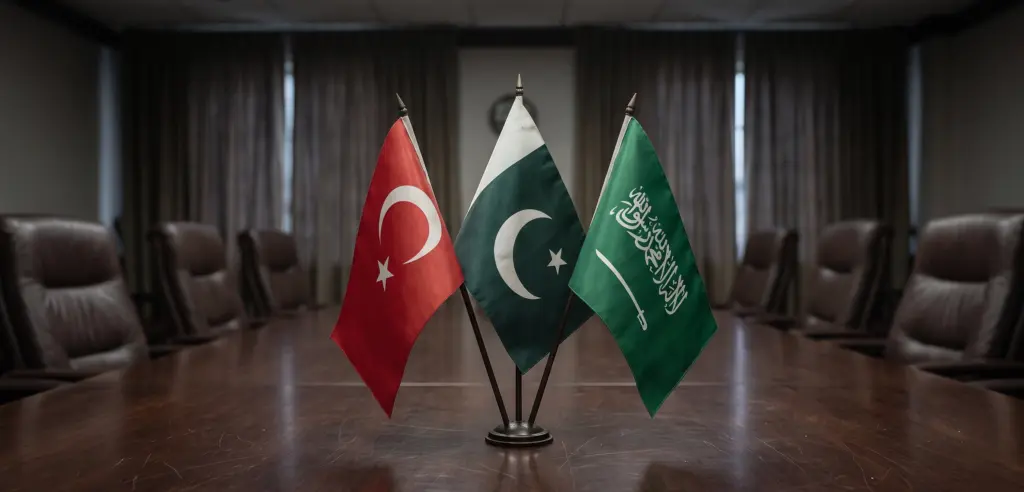
On 7 august, 2026, Pakistan, Türkiye, and Saudi Arabia signed a landmark agreement, the Makkah Joint Defence Agreement. The defining clause was that an attack on one state would be treated as an attack on all three. By strengthening collective security, the agreement deters outside powers. However, some commentators dub this agreement a Muslim NATO or a Saudi hedging strategy to diversify its security. Yet, another aspect remains undiscussed: how does this pact form a transregional security complex? This article argues that the Mecca agreement interconnects previously isolated regions-the Gulf, the Eastern Mediterranean, and South Asia- into a transregional security complex.
Regional Security Complex Theory (RSCT) refers to security cooperation among countries within a regional framework to enhance security and stability. The cooperation involves exchanging information and intelligence, training of security forces, and defence-industrial collaboration. It is important to note that this theory considers regional proximity a key determinant of security interdependence because threats travel directly to interconnected regions. Nevertheless, changes in military technology, political alignments, and strategic partnerships transform the boundaries and structure of a regional security complex.
One striking feature of modern warfare is the shrinking distance. For instance, missile technology with increased speed can cross continents in minutes. An attacker can launch weapons from their home country, reducing the need to have bases close to the enemy. Similarly, drone technology is another revolution that blurs the borders. They can fly for hours, cross long distances, and strike targets. With precision targeting capabilities, these weapons can identify the target and strike. For instance, during the Iran-US war, Tehran launched missiles and drones targeting countries that don’t share geographical proximity. It can be observed that because of modern weapons, the traditional logic of long distances and borders has lost value.
Not only did the US-Iran war expose the limits of existing security architecture, but it also pushed the formation of a new regional security complex. The conflict demonstrated how insecurity can spill across borders, threatening energy infrastructure, maritime routes, and regional partners. Saudi Arabia was vulnerable due to its reliance on an external security guarantor, creating an urgent need to seek alternative regional security partners; for Pakistan and Türkiye, instability in the Gulf affected their energy and strategic interests. This situation led to shared interests that increased mutual security dependence. It can be argued that the war caused a strategic necessity for a security complex, which is institutionalised through the Mecca Agreement.
In the context of RSCT, strategic compatibility refers to how well states’ goals and alignments affect the security complex. Aligned goals, alignment, and shared threat perception enhance utility and stability. The strategic value of the Mecca Agreement lies in its compatibility. Saudi Arabia brings substantial financial resources, a strategic location at the intersection of the Gulf and Red Sea, and energy powerhouse with significant investment in advanced military capabilities. Türkiye, NATO’s second-largest military, has an advanced indigenous defence industrial complex, including drones and electronic warfare. Meanwhile, Pakistan not only contributes a strategically important position but also a nuclear deterrent shaped by decades of strategic competition with India. In addition, Islamabad’s extensive military experience and a developed missile stockpile provide another cushion for the alliance. Taken together, these capabilities are not additive but potentially complementary, creating the basis for a security partnership that extends beyond bilateral defence cooperation.
More countries are willing to join the agreement, which will strengthen the transregional security complex. Bangladesh has expressed its willingness to join the agreement, and Turkish President Erdogan said that Egypt could join the joint defence agreement. If it happens, the scope of the Mecca pact will widen. Bangladesh would extend the arrangement into the Bay of Bengal, while Egypt would connect North Africa and the Eastern Mediterranean. The original trilateral framework could therefore become the nucleus of a wider network linking the Middle East, South Asia, the Mediterranean, and the Asian ocean. It highlights that this agreement’s importance may lie not in the three states that signed it, but in the network of states it could gradually connect.
Nevertheless, to build a mature security complex, political commitments should translate into operational mechanisms. Joint military exercises, intelligence sharing, defence-industrial cooperation, air and missile defence, unmanned systems and interoperable command structures could gradually transform political commitments into a functional security complex. At the same time, divergent interests may hamper progress. For instance, Saudi Arabia remains focused on Gulf security, Pakistan’s main concern is India, and Türkiye has a broader agenda spanning the Middle East and Europe. Therefore, signatories will have to construct strategic compatibility. To sum up, the significance of the Mecca Defence Pact lies in the changing geography of security. By connecting South Asia, the Eastern Mediterranean, the Gulf, and the Asian ocean through defence commitments and integrated capabilities. The agreement represents an emerging form of transregional security cooperation. Modern military technology has already weakened the protective value of geographic distance. The Mecca Agreement could provide an institutional framework for managing the resulting interdependence. Whether a conflict involving one member may still be regarded as a purely regional event will determine its eventual significance rather than whether the three states fight a war together.


Muhammad Kumail Mehdi is a Research Assistant at the Center for International Strategic Studies, Islamabad.


